Tuesday, July 22, 2014

All Things American


Phoenix rises from Sarton's grave
Our travels homeward from Canada led us back to our friends in Maine to weather out storm Arthur (three inches of rain in 18 hours!); then through beautiful New Hampshire where we visited the grave of May Sarton in Nelson; then into Vermont where we stopped to pay our respects at the Robert Frost Stone House Museum near Bennington. We pushed on to New York where we biked around Saratoga Spa State Park, a beautiful park with springs, swimming pools, geysers, tennis courts, golf courses, hotels, restaurants, historical buildings and  much more. (Put it on the must-see list and allow more than the three hours that we gave it.) After that we met up in Ithaca with our Florida friends Donna and Fran, on their way to the Maritime Provinces in their 26-foot motor home plus tow car. Piling into their little vehicle, we circled Lake Cayuga and paid our respects to the ladies (and gentlemen) of Seneca Falls at the Women's Rights National Historical Park which commemorates the first Women’s Rights Convention of 1848. We also enjoyed a rainy afternoon on the Cornell University campus, taking in the Johnson Art Gallery and the Sapsucker Woods Ornithology Laboratory where we amused ourselves in the bird and animal sounds lab. And of course the four of us went out to a fabulous last-night dinner at the famous Moosewood Restaurant.

Organic U-pick blueberries in New York
Heading west, we stopped at the Corning Museum of Glass where we learned a great deal about glass: how it’s made, how it breaks, safety glass, fiber optics, glass blowing and the history of glass. It’s a fabulous museum and also includes a stunning collection of glass art. Then it was off to immerse ourselves in the phenomena known as Chautauqua, an historic resort community by Chautauqua Lake, New York. Founded in 1874 as a summer school for Methodist Sunday school teachers, Chautauqua became associated with a concept of adult education and summer entertainment that includes lectures, performing arts, religious study and recreation.  In the early twentieth century the Chautauqua concept was so popular that traveling versions evolved and radiated across America. Today the nonprofit Chautauqua Institute convenes every summer to host lectures, performances, and art exhibits for the 8000 residents that come each week and stay in the hotels or their own cottages. Intrigued by the concept, we purchased $5 bus tour tickets and were shown much of the grounds by an enthusiastic middle aged docent who had grown up summering at the resort. We jumped ship at the bookstore and took ourselves on a little stroll through the grounds as well. But to appreciate Chautauqua, one might need to become immersed in the program. It’s a place geared toward the exploration of ideas and the appreciation of arts; but our impression from the bus tour was of a privileged and exclusive summer resort.

We are always looking for roads that have authentic experiences and local meaning attached to them. With that in mind we headed for the Ohio River Scenic Byway, a lush river valley splendid with summer greenery. The 960-mile highway travels through Ohio, Indiana and Illinois and one can frequently look across the Ohio River at West Virginia, Kentucky and Missouri. We started at the northeastern most point and followed it for 150 miles or so before turning off for our next rendezvous. As we followed this highway, we alternated between marveling at the natural beauty and feeling appalled by the countless factories, nuclear power plants, coal plants, and barges transporting coal and gravel up and down the river. But the farms and little towns were beautiful, including Steubenville Ohio that featured historic murals, an idea that was brought all the way to Steubenville by someone who was inspired by the murals in Chemainus, BC.  We then headed to Tar Hollow State Park near Chillicothe Ohio to meet up with our Kentucky daughter and son-in-law, for a fun and peaceful, albeit wet, weekend in the woods. 

Wow! We are amazed to find ourselves moving right along into the mid-west. Yesterday we drove across Indiana on the National Road, US Route 40. This was the first federal highway across America and was authorized during Jefferson’s administration in 1808 to connect the Potomac and Ohio rivers. The Indiana section was completed in 1834 and remained the state’s major east-west road until Interstate 70 was built in the 1960’s. Today it links little historic towns that are aging in various ways, and goes through the middle of Indianapolis. In between the towns are fields of soybeans and corn and little springs supporting native plants. Tomorrow: Illinois. We are moving west and seeing America.

Friday, July 4, 2014

Music and More in the Maritimes


We enjoyed "Tea with Eleanor"
We are finally headed back to the USA after nearly seven weeks in the Maritimes. Tonight we are on Campobello Island, famous summer retreat for Franklin and Eleanor Roosevelt, a truly lovely spot for our last night in Canada. The Maritimes were more than we ever imagined and we are sad to leave, especially, as we have discovered, now that the tourist season has just started. We now know that there are many major public events and festivals that don’t start until the official season kicks off on Canada Day, July 1st.  We were somewhat disappointed not to have found more music, but did find a few venues that gave us a taste of what the islands have to offer.

Our favorite has to be the Celtic Music Interpretation Centre in the tiny village of Judique, Cape Breton. This area is home to Natalie McMaster whom Friday Harbor music lovers will remember from her sellout concert on our island about a decade ago. We were so impressed with her ability to dance, sing and play the fiddle all at the same time. We didn’t get to see her here, as she is again touring in the US and Canada (this time with her fiddler husband and five young children!) But at the Centre we learned about her musical family, and had a great time learning to hear the differences in fiddle tunes that make up sets for dancing: reels, jigs, strathspeys and more.  We tried our hands at playing a fiddle and our feet at Scottish dancing (which resulted in a lot of laughing at ourselves.) And we enjoyed local seafood for lunch at the Centre while two musicians performed Celtic tunes. Judique is one of several coastal villages that continue a unique musical tradition that came from Scotland over 300 years ago and singing and dancing are a big part of life here on the shores of Cape Breton.

Lilypad down on the Shepherds Farm, PEI
A couple of days later we were in bustling Charlottetown, capital of the Province of Prince Edward Island. There on a warm summer’s evening we found a street band set up to entertain the customers of a half-dozen restaurants and we had a delicious meal while enjoying  young people playing jazz. Charlottetown is the home of “North America’s longest running musical”, the story of Anne of Green Gables but, as noted above, our travels were ahead of the tourist season and we were there just a few days too early to catch the opening show of the season. What we did enjoy, however, was an overnight at a Harvest Host site, The Shepherds Farm near Mt. Stewart. Our host Stephen Cousins gave us a tour of the farm and supplied us with organic new potatoes and asparagus for supper (as well as internet and a full hook-up, all at no cost.)

Summerside Baywalk has exercise stations, too!
From there we drove through spectacular agricultural lands, new green crops in iron-rich red soil complemented by roadside lupines in full glory. We accidentally stumbled onto a “Gathering of the Clans,” at the College of Piping and Celtic Performing Arts in the town of Summerside. In spite of the warm temperature (30 degrees Celsius) we enjoyed the bag pipe and drum marching bands from the Halifax Citadel and Moncton, NB. We left early because of the heat, figuring ourselves to be fairly wimpish given that most of the performers were playing, marching about in the full sun AND wearing wool. But we went on to discover Summerside’s “Credit Union Place” that houses an Olympic size pool, waterslides, hockey rink and harness race track. It was fun to cool off in the pool and watch the horses trot by on the adjacent track. That night we boondocked at the terminus of the Baywalk, a 7 kilometer walking and biking trail that goes along the waterfront and features sites interpreting local natural and historical features. 
Our next destination was the northwestern tip of PEI. We landed in Tignish in time for the annual Irish Moss Festival Parade, an event that lined the streets and featured most every antique tractor from all of PEI. We learned that Irish Moss, a sea vegetable containing high amounts of carrageenan, is still commercially harvested with horses here at North Cape. It’s a fishery that starts up as soon as the spring lobster season ends so folks shift gears and head back to the sea for a living once again. The North Cape of PEI also has hosted a major wind turbine research center since 1981 and sports an interesting visitor center and a four star restaurant overlooking the Gulf of St Lawrence. Coming back down the island the next day (after boondocking outside of and touring the Potato Museum) we meandered over to the Acadian Cultural Center at Abram Village where we enjoyed an Acadian lunch and a great concert by six people singing, dancing and playing a total of at least 14 instruments. 

We love Canada where everyone seems less fearful and more relaxed about most everything.  But will be back in the US tomorrow. No Nancy, we aren’t becoming Canadians. Well not on this trip anyway.

Friday, June 27, 2014

Migrations in Nova Scotia


We’ve been travelling in the beautiful provinces of Nova Scotia and Prince Edward Island and find ourselves humbled to discover how little we know about British and French colonization that shaped the United States and Canada into the remarkably different countries they are today. Crisscrossing Nova Scotia, we became fascinated with how the histories of our two countries are linked. The stories we found about immigration and emigration, both voluntary and involuntary, are interesting, sad and compelling. 

Gray day in Peggy's Cove on Southwest coast
The Immigration Museum in Halifax informed us that currently one in six Canadians is an immigrant. This museum occupies a building on Pier 21 where a million newcomers from countries all over the world were welcomed into Canada between 1928 and 1971. While it presented an inviting picture of the celebration of diversity in Canada, the museum was silent on the earlier migrations documented at a couple of other sites we visited around the province. 

One was the Black Loyalist Museum in Birchtown, near Shelburne. During the American Revolution thousands of escapees from American slavery were promised freedom, money and land in exchange for service to the British cause. When the English lost the war, these refugees were relocated in Nova Scotia along with other New England loyalists. But racism was alive and well:  the white Loyalists were given good farm land and black Loyalists were given the rocky infertile soil that no one else wanted. The combination of apartheid culture, infertile land, dearth of livable wages, and the harsh reality of northern winters doomed all but the most hardy. Some were later relocated to Sierra Leone (and that’s another story.)  A CBC television mini-series will soon air based on the historical novel, The Book of Negroes by Lawrence Hill, telling the remarkable story of one of these survivors. The controversial title comes from an historical document that listed the names of people who were eligible to participate in the relocation to Nova Scotia.

Grand Pre: Parks Canada National Historic Site
For part of our Maritime travels, we were joined by our in-laws, Ward and Ann Marie Carson from Vashon Island. They traveled with us for a week and we had a delightful time telling stories of our shared grandchildren and getting to know these very fine people.  The four of us visited Grand Pre, a commemorative site recognizing the 1755-1760 eviction of French colonists in the Annapolis Valley on the Bay of Fundy. These peaceful Acadian farming communities tried to maintain neutrality after the British arrived, unwilling to take up arms against France and refusing to take an oath of allegiance to the British crown. In retaliation the British forcibly removed men women and children from the land they had been cultivating for five generations, putting them on boats to the American colonies of Pennsylvania, Maryland and Virginia. Many were separated from family members or died of disease and starvation. Those that made it created a diaspora of Acadian culture and French language as far away as Louisiana.

Ward, unidentified "dragger", Janna, Liz and Ann Marie
Continuing to learn about provincial history, our next visit was to a coal mine. Coal mines in Nova Scotia are all closed now but the area is still dependent on coal for generating electricity, and it is currently being shipped in from South America. As a child Liz learned Peggy Seeger’s mournful ballad of the Springhill Mining Disaster of 1958, so Ward and Ann Marie and Janna graciously indulged Liz for a Springhill coal mine tour. It was spooky to go into the old underground mine near where the “bump” in the earth took so many lives in the famous Cumberland mine disaster, the third and last major mining disaster in this area. 

On a lighter note we all enjoyed touring Cavendish, on Prince Edward Island, childhood home and source of inspiration for Lucy Maud Montgomery who wrote the famous book: Anne of Green Gables. Ann Marie was the only one of us who had read the whole series, but even Ward was heard to say he would have to put one or two into his reading pile after that visit.

Seeking enlightenment at Gampo Abbey
The culmination of our travels together was a three night stay in Baddeck, Nova Scotia. From there we greatly enjoyed a day on the Cabot Trail, leaving Lilypad behind and travelling the loop in 12 hours, in a car rented by the Carsons. Janna and Ann Marie were so entranced by the beautiful hooked rugs at the Cheticamp Les Trois Pignons Museum that they both left with small rug hooking kits. This craft has been a historical economic boon to Nova Scotia, and particularly this area, and we had previously visited the Hooked Rug Museum of North America, a must-see stop near Halifax. Also near Baddeck our group of four toured the Fortress of Louisburg, rebuilt by the Canadian government in the mid twentieth century. This fortress was originally built in 1719 to protect French interests in the area but was captured by the British and burned to the ground in 1745. Now there are 50 buildings open to visitors, staffed with re-enactors to show what life there was like from 1719 to 1745. There are many additional acres of ruins to explore, but the walk was long and the time was short. We had time to hear about the halibut fishing, walk through several buildings, have a conversation with a re-enactor Mi’Kmaq scout, then a cup of tea, and it was time to move on.

Baddeck was also home to Alexander Graham Bell and we twice visited the five-star museum devoted to his life and work. We learned that he was devoted to helping others and well-loved in this community where he settled as an adult. He primarily worked with the deaf and he was devoted to his wife, the former Mabel Hubbard, who was deaf and read lips. He invented many things but intentionally obtained few patents. Because Mabel was wealthy, his marriage allowed him the freedom to experiment in aeronautics, hydrofoils, electricity, and of course, all things related to the telephone and phonograph. He invented a predecessor to the iron lung, the metal detector, a fax machine and even a telephone that needed no wires. We spent a total of five hours in this museum and probably would have appreciated a few more hours there.
We sadly said goodby to Ward and Ann Marie as they left to catch their plane out of Halifax. We are spending another week in the Maritime provinces but have gone as far north and as far east as we intend to go, which means that we are headed home.

Sunday, June 8, 2014

Fossils in Nova Scotia: Joggins and George


Pausing for muskrat activity on the Sackville bike trail
We woke up on our street-end boondock alongside a wildlife marsh in charming Sackville, New Brunswick on Liz’s birthday. Soras and tree swallows were mating and the muskrats were busy, as we took a lovely morning bike ride, ending up at a thrift store in town. The birthday was off to a good start as we hit the road headed toward the (dreaded) eight-mile bridge onto Prince Edward Island. 
We bought lobster at a supermarket 
But the birthday girl’s idea of a good time did not include that drive over the bridge. She wanted a lobster roll for lunch and then to go see rocks and fossils. So we found some lobster and headed instead into Nova Scotia. Lilypad turned southwest along the Glooscap Trail, a scenic byway along the Bay of Fundy which takes its name from an indigenous Mi'kmaq creator figure who was said to have created Nova Scotia and controlled the tides. These tides needed controlling: they are the highest in the world, rising to the height of a five-story building.

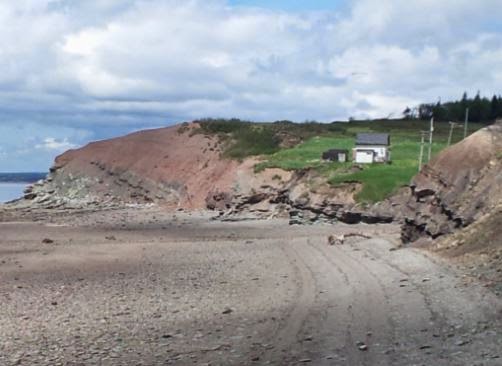
Fundy tides constantly erode the shore

The first stop along this route was Joggins Fossil Cliffs, a world-famous UNESCO site reflecting 315 million years of geological history. The site sports a LEED-certified building with fossil displays, café and gift shop. Enthusiastic young people lead tours down to the beach to point out the remains of the 20th-century coal-mining operation, and the fossils and geology that are continuing to be uncovered by the tidal action.
 310 million year old trees
Fossilized organic material including giant seed fern trees, primitive fish, insects and amphibians have been found along the coal seams.  Reptiles found there lived 100 million years before dinosaurs and it was their descendents that gave rise to dinosaurs and mammals. These fossils show that this area was once a warm-climate swamp, and the Joggins discoveries have greatly expanded how western science understands the earth’s history including the fact that Nova Scotia was once located near the equator. The cliffs were mentioned by Charles Darwin in Origin of the Species as part of his argument for evolution, and the visitor center displays an interpretation of this controversial intellectual history with odd echoes of our current controversy about the truth of science.
Partridge Island is famous for gemstone collecting


Our interest in all things rock being whetted (well, actually Liz’s interest, because Janna is deeply embedded in volume two of the Blanche Weisen Cook biography of Eleanor Roosevelt), we headed along the coast of Chignecto Bay and the Minas Channel where Liz filled her pockets on lovely low-tide beaches. After lunch we stopped to learn more about the tides and current attempts to harness tidal energy from Mary McPhee, the delightful and knowledgeable site director of a nonprofit organization called The Fundy Ocean Research Center for Energy (FORCE) a leading test center for tidal energy technology. She herself was a force, and her depth of knowledge about the research and experimentation going on, left us breathless. This work will likely evolve to extracting renewable clean energy from the vast tidal flow in the Minas Passage to power a million homes in Nova Scotia. Check out the impressive video on their webpage.
Site for newest tidal effort in the greater Bay of Fundy
Another interesting footnote: both of the young women who so impressed us with their work, Jessica at Joggins and Mary at FORCE, grew up in the area and became interested in their respective fields because of the work of their ancestors. Jessica’s father and grandfather worked at the coal mines where the fossils were discovered. Mary’s father and grandfather were fisherman and she grew up learning about the tides and deep waters of the Bay of Fundy. Her father always believed there should be an attempt to harness the tidal energy. 


Another night boondocking, this time at the Fundy GeologicalMuseum in Parrsboro.  Not having asked permission this time (it’s true: we are getting more and more brazen) we left early the next morning and waited in the parking lot for the Parrsboro Rock andMineral Shop and Museum to open. This turned out to be a move that was serendipitous and an experience we won’t forget. The owner of the shop, seeing us in the store parking lot through the window of his home next door, decided to come and open the shop himself instead of waiting for his employee. 
Liz learns from the master
We spend the next hour and a half in in the good company of 84-year-old Eldon George whose fossil discoveries made Parrsboro famous. Eldon was born in the house which is now the rock shop and was then the family homestead. He has spent his whole life finding rocks and fossils on the beaches nearby and continues to do so. 


He was nine years old when his wise mother realized he was finding things of significance and notified authorities. He was fifty-two when he found the tiny dinosaur footprints that put Parrsboro on the map and brought in experts from all over the world who determined that the smallest dinosaurs known lived in this area. In 1948 he opened the Parrsboro Rock and Mineral Shop and over the years has filled it with his rocks and collections. In addition to the rocks and fossils he’s personally gathered from the area, he has gemstones and minerals from all over Canada, and shells and amethysts from around the world, and he is currently negotiating with a museum to keep the collection in Nova Scotia after he is gone.
Eldon kindly identified Liz's rocks
 We spent a delightful morning with Eldon, looking at the rocks, the fossils and the accolades that have been showered on his life work, and admiring his jewelry.   Until recently Eldon did his own cutting, polishing and mounting in silver.We bought one of his pendants made of labradorite, a stone found mainly in Newfoundland and Madagascar, another example of the evolution and movements of the surface of the earth over the last 500 million years. Then several public health nurses bundled him off to the house and his much younger assistant came to take over the shop, but not before he gave Liz a big hug. We felt fortunate to have this quality encounter with someone who really is a national treasure of Canada.