Thursday, May 22, 2014

Boondocking on Grand Manan


Ferry to Grand Manan passes by Swallowtail Light

We drove off the ferry onto Grand Manan Island, New Brunswick to see “FERME” plastered over the sign for the provincial park campground which had been our destination. Since we are now seasoned boondockers, we set out to find an alternate site. Boondocking, for those of you who are not RVers, is overnighting in the motorhome away from a
Lilypad travels in steerage. Note cars in the rack above
campground and without the benefit of electrical, water or sewer hookups. We found a lovely spot and woke up the next morning looking out on the Bay of Fundy toward Nova Scotia. Just the previous night we had been boondocking near the town of St Andrews on a beach looking across Passamaquoddy Bay toward Maine. Around us we could see only trees and a house that appeared to be empty and no one ever knew that Lilypad was there.

No one seems convinced this is a good idea
But here, morning found an 80-or-so-year-old retired lobster fisherman watching the boats and wanting to chat. As we watched the salmon farming feeder boat steam past to tend floating salmon pens he remarked, “Me and the wife, we’re both fish-eaters, but we won’t eat those salmon.” He told us that when the pens first went in all the salmon in them got salmon lice, and the medicine they added to the feed pellets killed off all the lobster and periwinkles in the area. “Now,” he says, “those are starting to come back.” We have learned a lot from such conversations with locals and it’s these chance encounters that make all the difference in our camping experience.
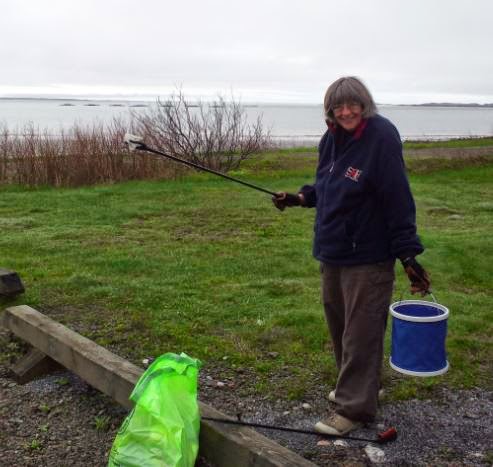
Tools of the trade....for a free campground.
We try to give motor home travelers a good name by getting out our trash bags and our long-handled litter pickers and cleaning up the area where we stay. The next night we boondocked at Seal Point, another road end on a deserted beach, and in the morning started our rounds. Soon two gentlemen came by who turned out to be geologists and explained to us in very technical terms the cause of the gorgeous red and green striations in the uplifted bedrock. They also thanked us for the cleanup.
Great eider and scoter viewing from the living room
We’ve discovered boondocking requires vigilance. You need to understand is how your rig (aka your motorhome) works. While it’s not difficult to make sure the water tank are full and the wastewater holding tanks are empty, making sure the house batteries are fully charged and stay that way while you are boondocking gets a little more complicated (especially if you are boondocking for more than one night, as we have learned the hard way.)  The third day on Grand Manan we finally found a campground that had just opened for the season, but the thought of spending $40 for electricity we could generate ourselves gave us second thoughts. We bought a couple of $2 showers, filled our fresh water, and set off to explore another part of the island.

Cather oversees museum cleanup
We have to admit, part of our joy in the exploration of this island was the fact that we are still ahead of tourist season. Even though our usual haunts, museums and nature centers were closed, we were lucky enough to stumble into the history museum on board-meeting day. The director and her assistant were preparing for the gift shop committee to come finish painting their new space but she let us in and was even willing to show off various aspects of the museum. A delightful find was a small altar dedicated to Willa Cather who summered many years on Grand Manan with her life-partner Edith Lewis, surrounded by accomplished other women literati and artisans. Known as “the Cottage Girls” these women caused quite the stir on the conservative island by wearing the latest fashions of jodhpurs, boots, and flannel, and enjoying luxuries such as books, cigarettes and liquor during the 1920’s and 30’s.

Lilypad at Dark Harbor - truly the end of the road!
Later we were enjoying the early evening light at Dark Harbor (and wondering if Lilypad could maneuver the small turnaround area to retreat back up the hill) when we were swooped upon by a middle-aged beer-drinking couple on an ATV who cheerfully greeted us with a loud  “You’re the first tourists of the season.” We do love meeting locals but gracefully declined their offer to park in their driveway. 

The question of where to boondock is always a major challenge. Many big box stores now give permission to motor homes to park overnight. We always ask permission and they don’t always say yes, but usually they do. We have parked at Wal-mart, Home Depot, Lowe’s, Costco, Camping World, Cabello’s, and an outlet mall. But none of these were available on the sweet island of Grand Manan, as (similar to our own island and with our hearty approval and blessing) they outlaw franchises. So for our last night on the island we ventured up to the airport. Since the island had been shrouded in fog most of the time we enjoyed a quiet night.
Grand Manan has several busy fishing centers
Needless to say, we loved Grand Manan and we are grateful for the boondocking that was easy to find there. We were also intrigued by the herring fishery history (home of the Connors Kippered Snack!), the eiders, the red deer antler operation (fairly amazing), the three lighthouses, and the dulse industry. After several conversations with islanders, we were deeply impressed by their amazing resiliency to weather and hard economic times. There are many interesting things here that call to our island spirits.  It is surely a place that warrants a return trip.

Back to the main land we are still boondocking, now at Costco in the city of St. John.  In the past few months, boondocking has also led us to spend the night in a hospital parking lot, a county courthouse parking lot, a commuter parking lot,  a couple of visitor center parking lots, on quiet residential streets and best of all, in driveways of people’s homes, both old friends and friendly folks we just met.

Our home is small but we love the neighborhood.  And what a view.

Friday, May 16, 2014

The Good Life in Maine


Cape Neddick Light House, Maine
We’ve had a week or so in Maine, findng new places, rediscovering old haunts, exploring new territory further “down east”, and even making some new friends. This land is reminiscent, but very dissimilar in some respects, of home, with beautiful seacoasts, big trees, and rocky beaches. Right now people in Maine are over-the-top happy that spring has arrived, because unlike the Pacific Northwest, they have long winters with lots of ice and snow; even the sea water freezes. But whatever images we might have had associated with the coast of Maine, they don’t compare with the absolutely beautiful reality we encounter. The ground is mostly different shades of solid granite; the houses are old and stately; the trees are just leafing out or coming into bloom; and the coastal vistas are breathtaking. Everywhere there are lobster restaurants, places to buy fresh lobster and lobster pots piled up in back yards.
 
Her books changed the world
One of our first stops was to pay our respects at the Rachel Carson National Wildlife Refuge outside of Wells, Maine. We wandered along the lovely interpreted nature trail near the refuge headquarters and learned a lot about salt marshes. Liz’s father, an avid gardener and naturalist, was a colleague and friend of Rachel Carson. He was very much at one with her model of being in the world, and Liz grew up knowing the importance of her work.

We also stopped  to explore the town of Rockland, with its intact historic downtown and lively arts scene. Our eyes were caught by the colorful storefront hosted by Project Puffin and we were lured by enthusiastic young people into the back of the store to watch a short documentary. We had not previously known about this project to restore puffin breeding colonies to Maine coastal islands. The Audubon-affiliated project was started in 1972 by ornithologist Steve Kress and his work has been replicated all over the world to reintroduce sea birds to habitat they once used. This model involves transplanting and feeding “pufflings” in new territories, then mounting realistic decoys to lure them back to the area when, after several years on the open sea, they are mature enough to reproduce. (See last October’s edition of the Audubon magazine for more details.)

Vincent surveys her beloved Camden Harbor
Our next stop was Camden, another little seaport town that was bustling with painters, construction workers and shop keepers getting ready for a short and lively tourist season. We stopped at the antiquarian bookstore and learned that Edna St Vincent Millay was born in Rockland and attended Camden High School. One of her school chums served many years as town librarian and collected everything Vincent (as she was known to her friends) and that collection is now in the archives of the library. So up we trooped to this incredible building and spent two hours leafing through newspaper articles, early poems and photographs, and references to Vincent’s younger years. We were amazed to learn she had led a very wild and rebellious life, enjoying dozens of lovers, most of them women. Liz’s mother had always been an admirer and, when she received her terminal cancer diagnosis, used Millay’s most famous quatrain to inform her email correspondents (including the governor and both Washington State Senators): “My candle burns at both ends; It will not last the night; But ah, my foes, and oh, my friends—It gives a lovely light!” ("First Fig" from A Few Figs from Thistles, 1920)

Then we landed on gorgeous Mt Desert Island and enjoyed an awesome Mother’s Day bicycle ride on the carriage roads of Acadia National Park. A few days later we found time to explore the village of Bar Harbor and drive the scenic Park Loop Road. 

Poster design from a Deer Isle local artist
We also reacquainted ourselves with a friend from Alaska days, Marianne New, now 94 years young. She cooked us a meal not once, but twice and refused all help for both preparation and clean up.  And she introduced us to her dear people, Nancy and Warren Berkowitz, who kindly let us park Lilypad in their backyard and quickly seemed like old friends. They urged us to visit Deer Isle, which we did, in spite of having to traverse a bridge that was the twin (built with the same design, at about the same time) to “Galloping Gertie,” the famous (because it collapsed after only four months) bridge linking Tacoma to Gig Harbor Washington. The adrenaline rush was worth it when we got to explore Stonington, a working seaport that harvested $78 million dollars’ worth of lobster last year, and saw the artistry of Peter Beerits at Nervous Nellies Jams and Jellies. His work is whimsical, thought provoking, delightful.
Google: Peter Beerits Sculpture Images

We also had some great conversations with Marianne and the Berkowitzes about Helen and Scott Nearing, the back-to-the land gurus of the 1970’s. The 60th anniversary of their book, “Living the Good Life” has just been recognized by the Bangor Daily News as having a significant impact on the history and economy of Maine. Our new friends were involved in end-of life care for both Scott and Helen and are currently stewards at the Nearing’s stone house and farm at Harborside. We toured the property and admired the stonework in the house and barn and around the garden, mostly set by Helen when she was in her 70’s. Liz mowed the lawn while Janna learned about their legacy from an excellent video called, “Living the Good Life with Helen and Scott Nearing”. The title of their famous book resonates with us. We share many of the political and economic sentiments of the Nearing’s, and we are lucky enough to be living our own good life.


Tuesday, May 6, 2014

Boston Never Disappoints


What we love most about Boston is that it is a college town. Like Berkeley and Boulder and Nashville and Ann Arbor it hums with academics young and old discussing current events and imaging a better world. But unlike other college towns, Boston has many colleges, 33 to be exact, and everywhere you turn there’s another institution of higher learning, a library, or a plaza filled with people reading books. And when we find informed communities we find folks that use alternative transportation like subways and bikes and create wonderful connecting green spaces like the Emerald Necklace. We also find people concerned with global issues like climate change and dependence on fossil fuels. Harvard University is currently embroiled in a challenge to divest their endowment of funds pertaining to coal and petroleum and we look forward to staying tuned to find out how it all turns out. On our last day in Boston, after jamming ourselves on a rush-hour subway filled with conversations about graduation and summer jobs and career choices, we enjoyed hanging in the Harvard/MIT COOP, a bookstore to die for.
Janna discusses climate change with Kate

We spent time in Boston on our 2003 motor home trip but this time around we had the most excellent company of our dear friend Kate Toomey who lives and works in the city as a bicycle tour guide. Kate squired us about by either joining us on the T (which is the subway also known as the MTBA) or putting us on the right train and then waiting for us at the other end on her bike! (Do you remember the song Charlie of the MTA? This is the subway that inspired it and the history is most interesting.) 

Still a spark between us after all these years
Kate got us free passes into some of her favorite museums and we enjoyed getting to know the Institute of Contemporary Art with its expansive view of the Boston Harbor and the fourth floor galleries that included Nick Cave’s “Soundsuits,” full-body outfits crafted from objects found in antique shops and flea markets. We also ran out of time playing with all the interactive displays at the Museum of Science and loved the quilt exhibit at the Museum of Fine Arts. Liz’s favorite moment was the impromptu singing a duet of “Calon Lan” in the acoustically perfect Maparium of the Christian Scientist Mother Church.  Janna loved revisiting the Isabella Stewart Gardner Museum which, since we visited 11 years ago, has added a new wing and a fabulous cafe.  We recently read "The Art Forger," by B.A. Shapiro which centers around the still unsolved Gardner Museum art heist, still evident by the empty frames on the second floor. (Great book.)

Great seats for less than $30!
Then there was the last of Janna’s birthday treats: a Red Sox game at Fenway Park. What a wonderful, well-loved ball field! The city embraces it and walking into the stadium is like walking into the store next door. There’s very little parking near the field so folks stream in from all directions to converge at this historic place. And when their team does something right (which they had a hard time doing the night we were there), the crowd is indeed deafening.

Enjoyed great fellowship at Glosta UU
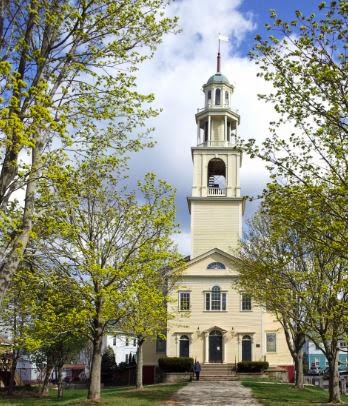
We left Boston in time to attend a musical service honoring Pete Seeger at the Gloucester Unitarian Universalist Church. It is a beautiful old church, in fact the very first Universalist church in America and we were made to feel most welcome by the small but friendly congregation. People who knew Pete were there, and stories about him brought tears to our eyes. A week earlier we had stopped at Beacon, NY, his adopted town on the Hudson and paid our respects at an Arbor Day event, met the Mayor, ate funny piles of sticky rice and listened to a pretty good band made up of mostly middle school children. We thought of Pete as we drove through the historic Hudson River downtown and noticed every little shop was open, folks sitting on the sidewalk outside of cafes, and every parking slot filled. Down by the river there were huge brick factories from bygone industries, decorated with graffiti, but they, too seemed to have new life and purpose. 

On May 3rd Pete Seeger would have turned 95 and all across New England communities are trying to figure out how to reflect his legacy. Pete taught us that progress is all about rolling with the changes, claiming historic urban architecture for current needs, encouraging young people to go back to the land and grow good food, and finding ways to clean up industries and make them accountable to their customers, workers and neighbors. People everywhere like to speak up about either how it was, or how it should be, and we try to listen. Pete seemed to believe that both messages have value, and so do we. He had an ability to communicate compassion because he could see that life everywhere is hard, and yet had an unfailing message of hope and optimism.  So we try to keep in mind what Pete would have said and done and what he would have wanted us to do. And when things get too hard, there are always the songs he left behind. Indeed, how can we keep from singing?


Sunday, April 27, 2014

Racing Along Through Pennsylvania, New York and Connecticut


Janna supporting the local economy in Intercourse, PA
After escaping from the grit of Philadelphia, we were delighted to descend into Lancaster County, PA., home to many Amish and Mennonite farmers and land of nitrate-free sausage, non-GMO corn and wheat products, and free tasting rooms for all sorts of preserved foods.  We loved the Amish horses, tried not to gawk at the beautiful buggies, and had a couple of great cultural immersion activities: one at a huge grocery store called Shady Maple Farm Market in East Earle, PA, and then at Zook’s Fabric Shop in Intercourse, PA. We felt warmly at home in rural Lancaster County and were momentarily tempted to settle in and buy the Quilt Museum and Country Store (which we never saw because the owner had passed away and the place was closed and on the market.)

Bikers and hikers share the Appalachian Trail at mid-point
Instead we went on to Gettysburg where we toured the battle site, museum and historic town. Here Captain George Pickett suffered his ignominious defeat, forever captured on a huge painting called a Cyclorama which covers the space of two football fields on a 360 degree wall space inside the Museum and Visitors Center. The painting was completed in 1883 by the French artist Paul Philippoteaux, then lost, nearly destroyed, found, restored and brought here in 2008. The story of the restoration of the painting is as interesting as the painting itself. Leaving Gettysburg, we found a lovely state park called Pine Grove Furnace which, we soon learned, is the half-way point for the Appalachian Trail. It was fun learning about the trail and talking to pilgrims who were making the 2,184 mile trip. Then we ventured north to Carlisle, where we wanted to learn more about the notorious Indian boarding school there, but found no museums or historical markers commemorating this important and tragic history.  On to Hershey where, in addition to tasting chocolate, we learned of the philanthropy of Milton S. Hershey and the still-thriving school and company town he created. We also went to Nazareth, PA and toured the Martin Guitar factory, a refreshingly different corporate model. 

Vassar quidditch team scrimmage
So much in such a short time.  Crossing from Pennsylvania into New York, we visited an art museum at Vassar College, then stopped to watch the quidditch team practice for a game (yes, muggles quidditch, as in Harry Potter.) Next was two days in Hyde Park touring the Franklin and Eleanor Roosevelt sites. The Franklin Delano Roosevelt Presidential Museum and Library has just undergone a $53M renovation and has emerged as a five star attraction. We were reminded of what was accomplished during the New Deal including Social Security, the National Labor Relations Board, the Works Project Administration, the Tennessee Valley Authority, the National Recovery Administration and the Civil Conservation Corps. This extraordinary flurry of legislation pulled the United States out of the Great Depression and put millions of people back to work. Janna’s father was one of them, saved from hunger by joining the CCC’s , he was a great admirer of FDR, and we were happy to note that our visit to this museum coincided with what would have been his 99th birthday.

Liz visits with the Roosevelts at their home in Hyde Park
It took us two visits to get through the Hyde Park offerings, but that included a break for lunch at the Culinary Institute of America down the road, where we dined at the Catarina d’Medici Restaurant , and ate excellent Italian food served by students in an ongoing class. Then there was the information about Eleanor and the visit to Val-kill Cottage, her refuge and last home. Eleanor, of course, is much to be admired in her own right, especially for her progressive stands on integration and civil rights. Then after FDR’s death, she lived into old age writing a newspaper column and many books, and serving as a delegate to the United Nations where she chaired the committee that wrote the Universal Declaration of Human Rights. At her Val-Kill home she entertained many famous people including John F. Kennedy who came there to gain her support for his presidential campaign.

Janna got to celebrate her birthday this week in our favorite kind of campground: a free one. We were delighted when we crossed the border to discover Connecticut is one of the few states that allow overnight RV parking at rest stops. We happily queued up with the north-bound snow birds (returning from Florida) and climbed into bed. After breakfast and birthday presents in the rest stop, we headed to the coast for a lobster roll lunch, then spent a rainy afternoon and night at the Indian-owned Mohegan Sun Casino, the largest gaming facility in North America and a very interesting and impressive place. We are not big on gambling and shopping, and the local museum was closed, but we were delighted to learn a bit of history from the shuttle bus driver who,with only a little prodding, turned out to be a wealth of information about the Mohegans and the area in general. 

We find ourselves wanting to slow down a bit: tour less, read more, but we do have a date for another birthday-related treat in Boston in a few days. Stay tuned.